Many of my clients are complaining about the price of Raspberry Pi CM5. And I agree on it. Some people asked me to design a custom board for carrying Raspberry Pi Zero (or Zero 2). It was a kind of special Raspberry Pi HAT.
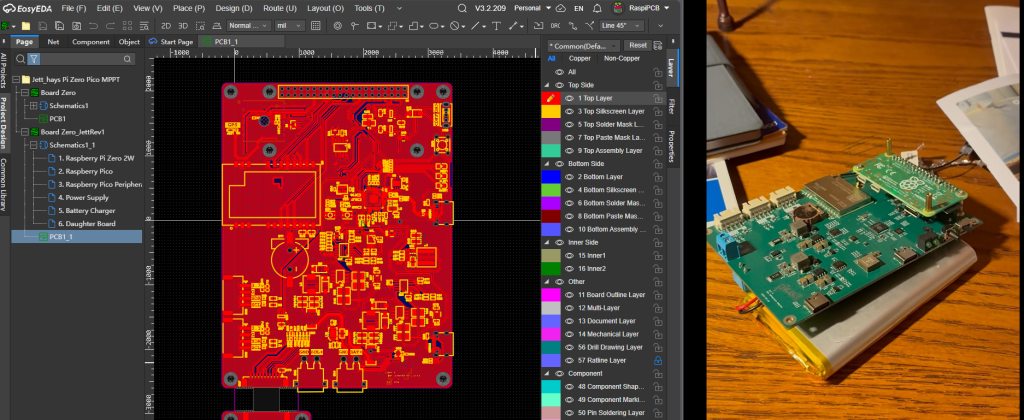
When we think about a HAT, it is a board that sits on top of Raspberry Pi. When we think about a carrier board, the Raspberry Pi sits on top of it. Essentially, if I design a carrier board for Raspberry Pi Zero, it becomes to a HAT design with 40p GPIO header. The below picture is showing one of my such board design. The PCB had a 40p GPIO header, and Raspberry PI Zero was powered by the board via the 40p GPIO header. On the PCB, I designed some power management circuit using RP2350A microcontroller. The microcontroller is acting like a power supervisor for managing low-power mode. Anyway, this board may not be looking like 100% perfect for some people. It is having the connector – 40p GPIO header.
To make such custom carrier board more professional, the most common way was to use Raspberry Pi Compute Modules – like CM4 or CM5. However, their pricing are getting expensive more and more these days. And not all people need the high performance and big RAM size of CM4 and CM5. Many people are running headless Linux on it for IO control, and accessing to it via CLI shell or web interface. In such case runnign some Python script or service is all they need.
And there is Raspberry Pi CM0. In my view, it is fancy module, because the internal hardware is exactly copy of Raspberry Pi Zero 2, hence, software compatibility is great. And it is a solderable module, instead of using a connector!
Finally, I met a client who liked to try CM0 with me. He asked me to design a custom Raspberry Pi CM0 carrier board. After my design he tested the board and the CM0 worked very well without any noticable issue like heating or noise. In the first design, there were some design errors related to SDR section, though it was not related to CM0 itself. After I updated the design, we could test and confirm that everything is working as expected.
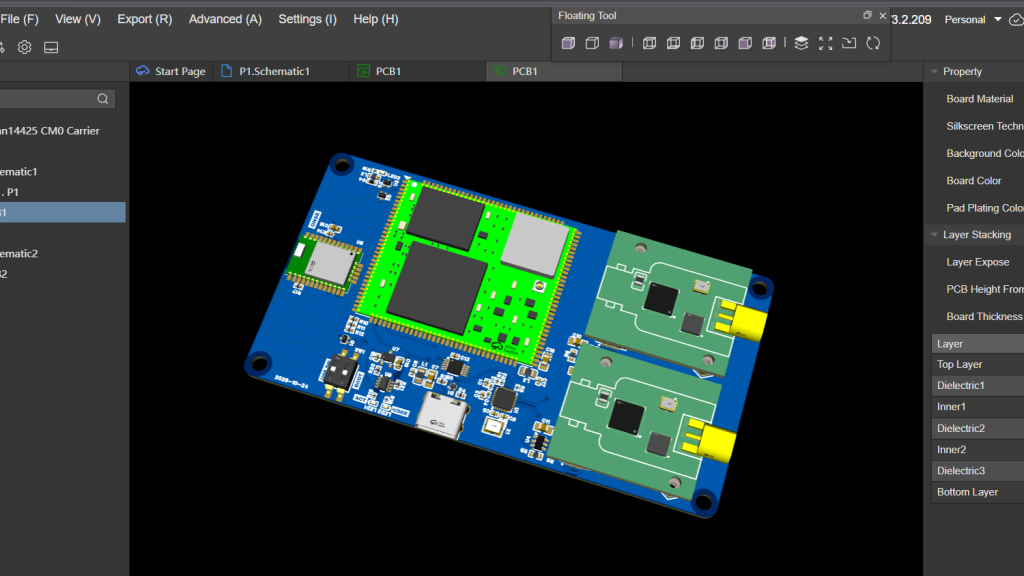
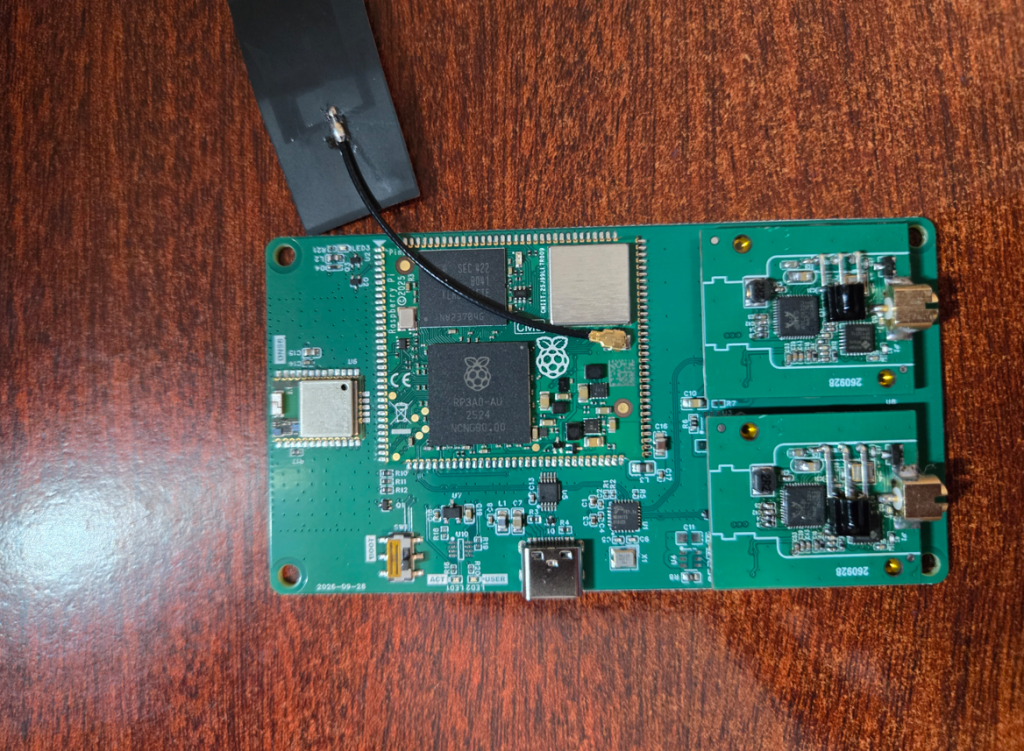
At the time of designing (it was Sep 2026), I checked availability of Raspberry PI CM0 in local Chinese market. Several local component suppliers confirmed that they have it several thousands in stock. And JLCPCB was also having it for a few tens of it. So, I used CM0CM0100008 (JLCPCB Par Number CM0100008), then we used JLCPCB PCBA service for prototyping. Below pictures are showing 3D preview and assembled prototype.
The Raspberry Pi Compute Module Zero – CM0 was good enough for this project, and worked out well. However, it may be still expensive for some projects. Though it was about half cheaper than CM5, it was still 2~3 time smore expensive than Raspberry Pi Zero 2. There are many cheaper alternatives for Raspberry Pi CM4 and CM5, but there are still little pin-to-pin compatible SoM alternative for CM0.
I hope that CM0 will have good supply in the coming years, and / or I can see more alternative pin-to-pin compatible SoM from other vendors. I am also going to design my own SoM that can be a cheaper replacement of Raspberry Pi CM5 and CM0. Of course, the software compatibility is not what I can achieve, like many other Raspberry Pi competitors tried and failed.
😀